By Katie Dick
As the United States of America celebrates its 250th anniversary, PressBox and the Babe Ruth Birthplace & Museum are teaming up to look back at Maryland sports history and highlight some of the local people and moments that changed the sports landscape throughout the course of American history. It felt fitting to begin with something that has multiple ties to Maryland and our national sporting landscape, “The Star-Spangled Banner.”
In mid-September 1814, Francis Scott Key found himself detained on a British warship in Baltimore’s harbor. Key, on board to secure the release of Maryland physician William Beanes, overheard plans to attack Baltimore and was prevented from going ashore.
On Sept. 13, the 16-ship, 25-hour bombardment of Fort McHenry began. The ships, keeping out of range of Fort McHenry’s powerful cannons, were just off-shore when Key bore witness to the battle. The next morning the dawn’s early light shone on Fort McHenry’s garrison flag. Moved by the sight, Key penned the first few lyrics of “Defence of Fort M’Henry” on a scrap of paper.
He would finish his poem at Baltimore’s Indian Queen Hotel, a state-of-the-art tavern and inn located at the intersection of Hanover and Baltimore streets. Key’s brother-in-law then set the poem to music (an English drinking song). Carr’s Music Store in Baltimore printed the sheet music and titled the song “The Star-Spangled Banner.”
The song was popular but mostly played at events, military occasions and parades. It wouldn’t officially be adopted as the country’s national anthem until 1931. Today, we are most likely to hear the anthem while we are attending a sporting event, but how did that come to be?
For that, we have to go back to Game 1 of the 1918 World Series. It was Sept. 5, and the Chicago Cubs were facing the Boston Red Sox at Comiskey Park. Here’s where baseball fans interrupt to point out our “mistake” — the Cubs play at Wrigley, not Comiskey! Well, Wrigley (Weeghman Park at the time) did not have the seating capacity to handle the crowd, so the game was moved to the south side of the city.
Meanwhile, the United States was engulfed in World War I. During the seventh inning stretch, President Woodrow Wilson instructed the military band to play “The Star-Spangled Banner.” He hoped the song would encourage families whose loved ones were fighting abroad in Europe.
Red Sox third baseman Fred Thomas, who had been granted a furlough from the Navy to play in the series, snapped to attention. And on the mound for the Red Sox at that moment was none other than Baltimore’s native son, George Herman “Babe” Ruth.
Ruth pitched a shutout in that game, but “The Star-Spangled Banner” was most talked about in the morning’s papers. When the 1918 series shifted to Fenway for Game 3, the “Star-Spangled Banner” was moved from the seventh inning to the pregame ceremony, where it has remained ever since.
If you’re from Maryland, you’ve probably yelled out the “O” in “O say does that star-spangled banner yet wave.” Or maybe you’ve had to stifle it at an occasion where it may be less appropriate. You’ve heard it at Orioles and Ravens games (home and away), at colleges, or when watching Katie Ledecky receive a gold medal on the Olympic podium. It’s a reflex for Marylanders. It’s so ingrained in our state’s culture that it feels like it’s always been there. But how did it start?
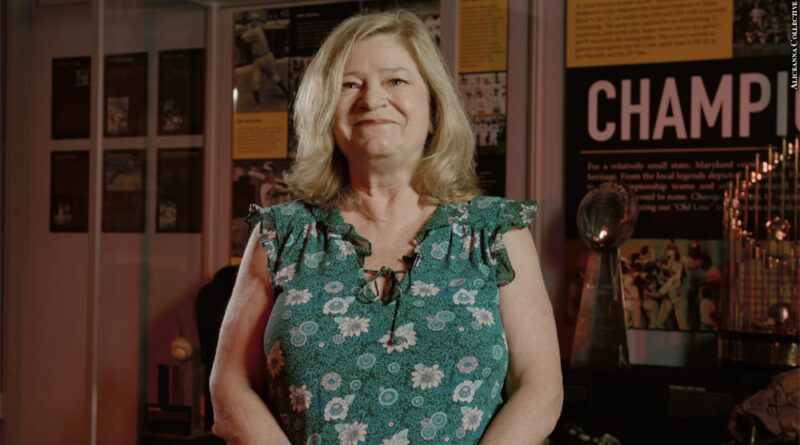
The setting is Baltimore’s Memorial Stadium, with a Dundalk cab driver named Wild Bill Hagy and Section 34. The iconic Orioles superfan could be seen moving his body to spell out O-R-I-O-L-E-S and leading chants from the upper deck with his Section 34 Rowdies. A member of Bill’s Rowdies, WJZ’s Marty Bass, was at the Babe Ruth Museum to film a “Where’s Marty” segment. He told us about another member of their gang, Mary Powers.
It was 1979, the year that “Orioles Magic” was born. After finishing fourth in the American League East in 1978, the Orioles had a magical comeback in ’79 and went 102-57 with a 55-24 home record. They had a strong team led by Ken Singleton, Eddie Murray, Doug DeCinces and Mike Flanagan. The Orioles had a new owner, Edward Bennett Williams, who purchased the club in mid-August and formally took over after the season. They had a new flagship station which helped usher in a new era of young fans. And the Orioles had Mary Powers.
Excited by the team’s success, the Rowdies would lead the cheers, creatively rhyming the players’ names into them, and they got big reactions from fellow fans and players. The team was so hot that summer that everywhere you went, folks were talking about them. Mary and the Rowdies started emphasizing the “O” in any word that had one.
One hot summer night, as the anthem echoed out of the speakers, Mary loudly yelled out “O!” And the reaction of people around her was … not so enthusiastic. But Wild Bill had a smile and twinkle in his eye, and the next night, he joined her. Before long, the cheer spread throughout the section, to the entire stadium, and to 47 years into the future where it has remained a charming local quirk. We have Mary Powers to thank for that.
The Orioles won the ALCS that year (three games to one against the California Angels) but fell to the Pirates in the World Series. Despite the loss, Baltimore threw a parade anyway. It was a celebration of the team’s grit and determination, their fans (many of whom were new) and the indelible spirit of Baltimore sports.
In honor of America’s 250th Anniversary, we want to explore moments like these, where Marylanders have taken something and made it their own. For such a small state, Maryland has contributed an outsized impact to not only sports, but the history of this nation.
Maryland is not just the place where “The Star-Spangled Banner” was written, it’s not just the place where the greatest baseball player of all-time was born, and it’s not just the spirit of sports fans like Mary Powers. It is all of these things and more — and we can’t wait to share them with you.
Katie Dick is the director of external affairs and curator at the Babe Ruth Birthplace and Museum.
For more Maryland sports history, visit PressBoxOnline.com/history
Photo Credit: Aliceanna Collective
The Babe Ruth Birthplace and Museum is an independent not-for-profit organization dedicated to preserving the legacy of Babe Ruth and all Maryland sports. Visit the historic row home where George Herman “Babe” Ruth was born and discover treasures from Maryland’s storied sports heritage. Visitors can see the Baltimore Colts’ Super Bowl V Trophy, Jessica Long’s 2004 Paralympic gold medal, Ruth’s rookie card, and so much more.
Located a short walk from Oriole Park at Camden Yards, the Babe Ruth Museum is open 7 days a week, from 10 a.m. to 5 p.m., and until 5:30 p.m. for Orioles evening home games.