
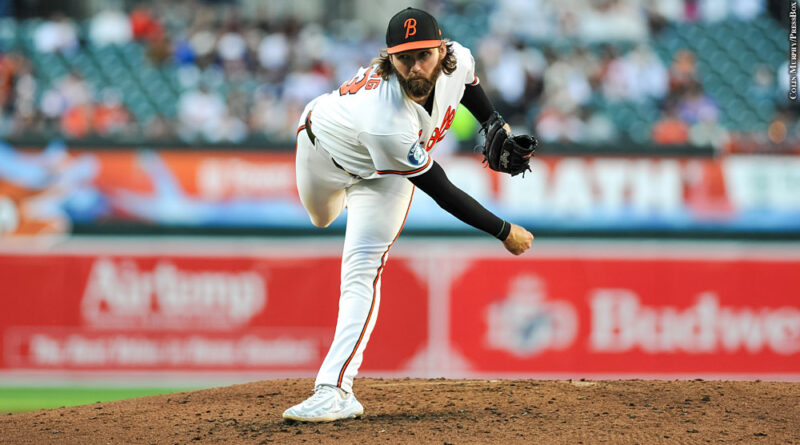
At 13 years old, Brandon Young’s baseball calendar had little room for days off.
During the week, the lanky Texas native pitched and practiced for Lumberton High School. On weekends, he suited up for the Texas Sun Devils, a Southeast Texas travel team. In between, he squeezed in bullpen sessions to refine his pitches.
Barely 150 pounds on a 6-foot-3 frame, the right-hander admitted he was “all arms” while throwing — a far cry from the soon-to-be 28-year-old pitcher with a 3.13 ERA in 97.2 innings (17 starts) for the Orioles in 2026.
One afternoon, Young climbed onto the mound to work on his curveball. Instead of breaking across the plate, the pitch dove straight into the dirt. Then he felt a pop in his right elbow.
At first, Young kept it to himself and brushed it off as no big deal. A few days later, he took the mound for a weekend tournament, and the results told him otherwise.
Young lasted five innings, but his command was way off. He walked batter after batter, unable to locate pitches in a way that once came naturally. His fastball, which had climbed to 86 mph before the injury, sat in the high 70s.
When he returned to school the following Monday, Young couldn’t even write his name on a piece of paper. He eventually learned he had torn the UCL in his right elbow and would need Tommy John surgery. Young didn’t fully understand what came next. To him, the surgery was a setback, not a transformation.
“I was like, ‘Oh, I’m going to get back. Just another surgery, whatever,'” Young said. “I’ve heard of guys throwing harder after, so I was looking forward to the rehab and all the work I was going to do. And it’s what I needed for sure. You get stronger and get the area built around it stronger.”
Before Young could begin the long road back, he had to confront another challenge — telling his father, Cary. He kept the injury to himself not only because he hoped it would go away, but because he feared how his father would react.
Cary spent 14 years in the Marines before working for two decades in the federal prison system, building a household centered around discipline and accountability. Young knew his father wouldn’t be happy that he had continued throwing after feeling something wrong in his elbow.
“When I told him, he was super upset,” Young said. “He wasn’t mad at me, but it’s just how it was.”
Looking back, Young understands why his father reacted that way. He also recognizes how much their relationship has changed. Since retiring, his father has become more relaxed, and the two can now look back on moments like that fondly.
“Since he’s retired from the prison system, he’s a totally different dude,” Young said. “It’s been awesome. We laugh about that stuff now, and he’s apologized.”
The surgery — performed in Houston with Dr. David Lintner, a surgeon renowned for treating athletes with elbow injuries — repaired Young’s elbow, but the recovery forced him to rethink how he took care of his body.
With his slender frame, Young didn’t just need a healthy ligament. He needed a foundation. His rehab focused on strengthening his core, adding weight and building the muscles around his arm to better handle the demands of pitching. Following the injury, he began working with a trainer he still works with today.
Young was cleared to return to the mound 11 months after surgery. But getting cleared and feeling like himself once again were two different battles.
It wasn’t until March 2015, nearly a year and a half after the procedure, that Young started to feel like the pitcher he was before the injury. That season, he touched 88 mph in Lumberton’s final playoff game — a reminder that the work he had put in was paying off.
But his comeback was still a work in progress.
In his first year back from Tommy John surgery, Young was still learning how to manage his workload and refine his approach. During the final game of his junior year, that learning curve collided with the often lofty expectations placed on young pitchers.
Young threw 153 pitches in the playoff game, surrendering nine walks and allowing 10 home runs. The outing became a talking point across Texas high school baseball and even landed him on the front page of a local media outlet.
It also became part of a larger conversation about how young pitchers were being used. Not long after, the Texas high school baseball association implemented pitch count rules designed to better protect players’ arms.
“I feel like nowadays everyone’s trying to throw hard,” Young said. “They’re throwing 100 at 15, 16 years old. I hit 91 my senior year, one pitch, my very last game. That’s considered slow nowadays.”
The same pitcher who once tried to overpower hitters with “all arms” had learned that staying on the mound required something different. That lesson carried with Young beyond high school.
Instead of following the traditional path to a Division I program, he spent two years playing junior college baseball at Howard College in Big Spring, Texas, before transferring to the University of Louisiana at Lafayette — a route he believes more young players should consider.
“Everyone wants to go D-I and get drafted,” Young said. “You can take a year off and train and like build a base. It’s not a one-size-fits-all.”
Young’s patience was tested again nine years later after signing with the Orioles as a free agent following the five-round 2020 draft.
After working his way through the minor leagues, Young suffered a second UCL injury and once again needed Tommy John surgery in April 2022.
This time, the physical recovery wasn’t the only challenge. Young understood the process ahead of him, but that familiarity also made the diagnosis more difficult to accept.
“It was pretty devastating because I didn’t think I needed TJ,” Young said. “I thought it was just a strain or maybe a tiny tweak or something. To learn that I needed TJ again, it was pretty disheartening.”
The timing made the injury even more difficult. While Young was stuck in rehab, others were making their debuts in the majors.
“I was just stuck and just seeing guys pass me up,” Young said. “It was a little depressing. It kind of built more motivation, but it was also so monotonous going day in, day out of the same stuff every day again.”
The second rehab process was even more demanding than the first. Young wasn’t cleared to return until June 2023, roughly 14 months after surgery, and he didn’t feel like himself again until spring training in 2024.
The hardest part wasn’t necessarily the pain. It was the frustration of knowing his body was healthy while his pitching still felt unfamiliar.
“Most of the time, you’re feeling OK, but it’s just not coming out how you want it,” Young said. “Your mechanics are a little weird. I haven’t thrown in six months. I’m slow. My arm’s late. And then once you get in a game, you’re like, ‘Holy crap. I can’t think about any of this stuff that I was thinking about, mechanics and timing wise. I’ve got to go get this guy.'”
For Young, the journey back was simply another reminder that development rarely follows a straight line.
“It’s cool to look back on that and know where I am now,” Young said. “I had TJ at 13 years old, 14 years old. It’s kind of new. Deep down, I’m still going to get over this and be a big leaguer. That’s what I’ve always wanted to do. So it’s pretty cool.”
Photo Credit: Colin Murphy/PressBox