
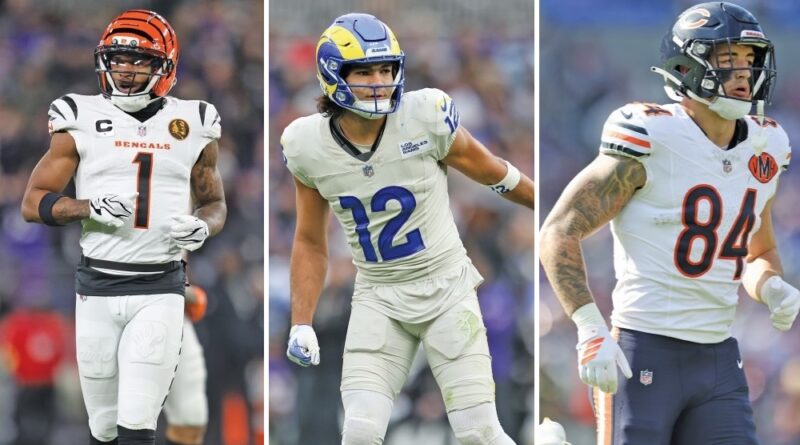
As terms of art, they’re not likely to be heard at an NFL coach’s news conference, but for the legions fluent in fantasy football it’s a familiar language.
Hero running back. Sleeper tight end. Ceiling. Floor. ADP. PPR.
Hundreds of fantasy football devotees conversant in the tongue of the annual obsession of selecting and managing theoretical NFL squads for fun and (occasionally) profit, converged on Canton, Ohio, in late July for the seventh annual Fantasy Football Expo, a conference and exhibitors show featuring an assortment of expert panels.
The event organizer is Bob Lung, a certified public accountant from Canton. He put together the first such Expo in 2019 and said the event has pulled attendees form every state in the country and even some internationally.
“The first year we only had 75 attendees. And then COVID hit in 2020 and we figured we’ll never have another public thing,” Lung said.
The event went dark in 2020 and then when society at-large reopened in 2021, 500 people showed up.
“It’s floated between 600 and 700 attendees ever since,” Lung said. “And it includes everyone from stay-at-home moms and dads to people with a master’s degree in statistics. That’s what’s great about the fantasy community. We always say that when you come here, we are all the same person. We’re here to talk fantasy football.”
This year’s Expo was held at the Canton Convention Center with ticket costs ranging from $20 at the door for a one-day admission to the trade show and panel discussions, to an all-weekend experience of $295 with Pro Football Hall of Fame admission, a special night out at a local sports bar, a meet-and-greet with fantasy experts, plus access to mock drafts, the panel discussions and the trade show.
So, what type of information floats through the Fantasy Football Expo? Here’s a sample:
1. The consensus on the top three picks in 2026 for the typical “redraft” leagues (meaning fantasy players start with a clean slate in drafting their teams) is set in stone. The three are, in no set order, Atlanta running back Bijan Robinson, Detroit running back Jahmyr Gibbs and Cincinnati wide receiver Ja’Marr Chase.
2. “Hero” running backs are called that because they can carry a fantasy team and because they’re becoming rarer in today’s NFL, with running back touches being shared in semi-committee fashion. Examples of pure hero backs are Indianapolis’ Jonathan Taylor and San Francisco’s Christian McCaffrey, although McCaffrey’s extensive workload is a voiced concern. At 24, Miami’s De’Von Achane is younger than other “Hero” back candidates. His name surfaced frequently at the Expo despite a smaller frame (5-foot-9, 191 pounds) than counterparts at the position — in large part for his receiving production.
3. With running back resolved on their rosters, experts naturally turn to receiver. While the Los Angeles Rams’ Puka Nacua, Seattle’s Jaxon Smith-Njigba and Detroit’s Amon-Ra St. Brown are sure to be selected in the first round, those selected later can be difference-makers for league championships. Overall, draft experts at the Expo leaned into the offensively-revitalized Chicago Bears. A later-round receiving favorite, Luther Burden III, was singled out.
4. The term “Sleeper” refers to a player at a position who can be gotten for cheap, meaning late in a draft, but who can still provide a solid “floor,” meaning a reliable number of fantasy points. A year ago, that was Chicago tight end Colston Loveland. With Arizona All-Pro tight end Trey McBride sure to be a high-round pick and Kansas City future Hall of Famer Travis Kelce edging toward retirement, there are tight ends deeper in the draft to look into, including the New York Giants’ Isaiah Likely, who reunited with his former Baltimore coach John Harbaugh, and the Los Angeles Chargers’ Oronde Gadsden II.
5. Fantasy experts wince at the mention of kickers because kickers inject an element of randomness in a competition that serious fantasy players would prefer not decide their contests. However, if your league does include kickers and if your league’s scoring rewards distance of field goals (three points for 39 yards or shorter, four points for 40-49 yards, and a whopping five points for 50-yards or longer), this position should not be ignored. Even the experts reluctantly make the point that a 50-yard field goal (five points) is more valuable in some formats than a quarterback’s short touchdown pass. The long boomers are Dallas’ Brandon Aubrey and Jacksonville’s Cam Little.
So, with Hero running back, Sleeper tight end and “floor” explained, what other fantasy vocabulary was tossed around at the Expo? A player’s “ceiling” is his expected high mark in an actual game. PPR leagues mean players receive a fantasy point per reception. ADP refers to a player’s anticipated average draft position, usually in preseason mock drafts.
Finally, ending with a bit of fantasy trivia. The first-ever fantasy draft was held in 1963 in Oakland, Calif. And the first player chosen — George Blanda.
Photo Credits: Kenya Allen/PressBox