
By Mike Gibbons
Baseball has enjoyed many great dynasties, most notably the Babe Ruth-era New York Yankees, also known as “Murderers’ Row.”
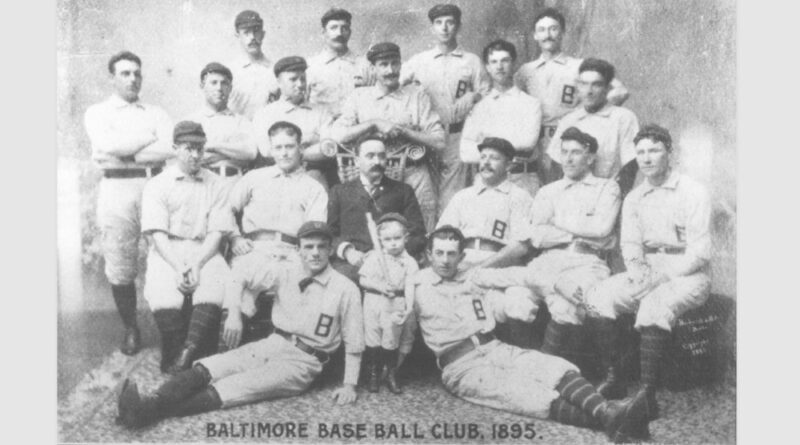
But before them came a scrappy Baltimore Orioles team that dominated the National League from 1894-1899. Led by foxy Hall of Fame manager Ned Hanlon, those Orioles invented small ball and finished first three consecutive seasons (1894-1896) and second twice, averaging 90 wins and 46 losses for an incredible .660 winning percentage. Even in 1899, when the team dropped to fourth place, they won 96 games.
Seven Hall of Fame players graced Baltimore’s lineup during that period, including John McGraw, Wilbert Robinson, “Wee Willie” Keeler, Hughie Jennings, Dan Brouthers, Joe Kelley and Joe McGinnity. They became notorious for sliding feet first with sharpened spikes and hitting the ball deliberately into packed clay around home plate, where it would bounce high enough for the batter to reach first safely. This scheme would famously be labeled the “Baltimore Chop.”
The 1890s Birds played for one run at a time, effectively using tactics like the hit and run and suicide squeeze to manufacture enough firepower to dominate the league. Willie “Hit ‘Em Where They Ain’t” Keeler specialized in bunting and base-stealing so proficiently that broadcaster Bill Stern called him “the most wonderful hitter that ever lived.”
Legendary Philadelphia Athletics manager Connie Mack referred to Hanlon as “the greatest leader baseball ever had.” Two of Hanlon’s players, McGraw and Robinson, went on to become the celebrated managers of the New York Giants and Brooklyn Dodgers, respectfully.
Baltimore played its home games at Union Park, located at 25th and Barclay Streets. Opened in 1891, the all-wooden structure had a seating capacity of nearly 12,000. At the start of the ’94 campaign, 15,000 fans, or “cranks” as they were called back then, crammed into the two-deck ballpark with high expectations. The Orioles did not disappoint, defeating the New York Giants, 8-3, in the opener, before sweeping the visitors out of town, four games to none.
An interesting tradition began around that time, and it revolved around visiting teams leaving their downtown hotels, meandering their way in open-air trolleys northward to Union Park. Orioles fans, after determining the trolley route, lined up to shower opposing players with a barrage of rotten fruit.
Once at the ballpark, fans could rack their bicycles on Barclay Street, while celebrity pugilist “Gentleman Jim” Corbett greeted his kid brother, Joe, who played for the Orioles. And Maryland Gov. Frank Brown and Baltimore Mayor Ferdinand C. Latrobe were there for all to see. At 3 p.m., the clubhouse gong sounded and the Orioles snapped to attention from their field bench (there were no dugouts back then) and it was time to play ball.
In 1890s baseball, the home team batted first. The leadoff man for the Birds was third baseman John McGraw, who clutched his thick-handled bat as he approached a square home plate. According to Baltimore baseball historian Jim Bready, McGraw screamed at New York pitcher Amos Rusie, “I’ll bounce that fastball off your corn cob skull, you dumb hick.” And so the season began.
Hanlon’s nine stayed among the top three teams in the 12-team league for most of the ’94 campaign, fiercely contending with New York and Boston for the title. Baltimore clinched the crown with a regular-season sprint, capturing 24 of its final 25 contests. The championship was secured on the road in Cleveland, after which team captain Wilbert Robinson sent the following telegram to his wife: “Cheer up, Mary, the flag is ours!”
The first-place finish was rewarded with a postseason appearance in the inaugural Temple Cup series against second-place New York. A precursor to the World Series, the Temple Cup matched the National League’s first- and second-place finishers and was contested for four years (1894-1897).
The Orioles again finished first in 1895, going 87-43. But as in ’94 they lost the Temple Cup, this time to second-place Cleveland. Baltimore came out of the gates slowly that year, losing the opener to Philadelphia.
Part of the problem could be attributed to bad luck. Heinie Reitz broke his collarbone, forcing manager Hanlon to shift pitcher Kid Gleason to second base. John McGraw fell ill, meaning Hanlon had to push more buttons. Team captain Robinson had to have part of a split finger amputated, though he never missed a game.
And then there was the presence of little Harry Howe, the team’s 4-year-old mascot. Harry was escorted to Union Park just before game time and then was returned home by an Orioles player around the fourth inning, or whenever he started to get cranky. The little mascot may have been more of a distraction than not. Nevertheless, the team finished strong enough to secure a second straight pennant.
1896 would be the best year of all. The Orioles unveiled a new championship banner on Opening Day. They plowed through the competition to finish 90-39, a .698 winning percentage, a pace that was almost unheard of. At the end of regular-season play, they were up on Cleveland by 9.5 games. And, for the first time, they clinched the pennant at home. Also, for the first time, they ran over the Spiders to capture the Temple Cup.
1897 brought an end to the team’s consecutive pennant clinches at three, though the Birds did win 90 games to finish second and then run roughshod over first-place Boston in the Temple Cup, four games to one. But it may be that off-the-field activity proved more pertinent for local sports than what occurred around the base paths.
Two of the team’s brightest stars, Wilbert Robinson and John McGraw, cashed in on their celebrity by developing and opening “The Diamond,” Baltimore’s first sports bar. They rented a three-story building at 519 Howard Street in the heart of the city’s downtown district. It was a combination saloon, bowling alley and gym.
As Jim Bready notes in his superb book, “The Home Team,” the bar was on the right as you walked in, with billiards and club rooms on the second floor. It was at “The Diamond” that, legend has it, two entrepreneurs invented Duckpin bowling.
“When a regular set of pins became too nicked for use,” Bready notes, “Robbie had John Dittmar and Sons, wood workers, lathe them down.”
McGraw was one of the first to try the smaller pins, and he likened the struck pins “to ducks rising.” Thus, the genesis of Duckpin Bowling, which remained popular in Baltimore well into the 1960s and was a favorite of Baltimore’s Bambino, Babe Ruth. Duckpin bowling’s legacy is further cemented in American culture by local champion Toots Barger.
In 1898, Baltimore started strong, faded and came back. Late in the season, the Orioles trailed Boston by three games and traveled to Beantown for a three-game showdown. They lost. And the Beaneaters won the pennant by six games with an astounding 102 victories.
1899 bore witness to the painful collapse of Baltimore’s historic run. Hanlon shifted his leadership skills to Brooklyn and took with him several Oriole stars including Kelley, Keeler and Jennings. Robinson and McGraw stayed, with the latter serving as team captain and manager.
The team, despite all its challenges, managed to finish fourth, going 86-62. That offseason the National League was forced to cut down from twelve teams to eight. Orioles ownership, with strong ties to Brooklyn, opted to pour their resources into the Superbas ballclub.
There would be no baseball in Baltimore for the 1900 season, but the sport’s first great dynasty became etched into baseball (and Maryland’s) storied sports heritage.
Mike Gibbons is the director emeritus and historian at the Babe Ruth Birthplace and Museum.
For more Maryland sports history, visit PressBoxOnline.com/history
Photo Credit: Courtesy of the Babe Ruth Birthplace and Museum
The Babe Ruth Birthplace and Museum is an independent not-for-profit organization dedicated to preserving the legacy of Babe Ruth and all Maryland sports. Visit the historic row home where George Herman “Babe” Ruth was born and discover treasures from Maryland’s storied sports heritage. Visitors can see the Baltimore Colts’ Super Bowl V Trophy, Jessica Long’s 2004 Paralympic gold medal, Ruth’s rookie card, and so much more.
Located a short walk from Oriole Park at Camden Yards, the Babe Ruth Museum is open 7 days a week, from 10 a.m. to 5 p.m., and until 5:30 p.m. for Orioles evening home games.