
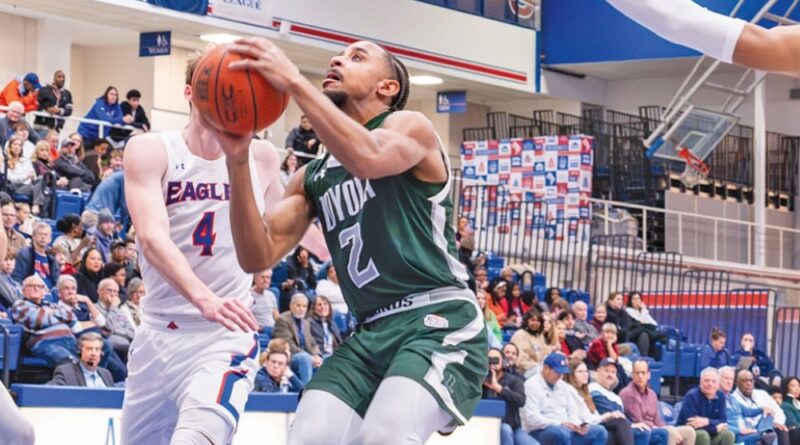
Loyola men’s basketball senior Troy Cicero Jr. recently chatted with PressBox about why he loves playing for Josh Loeffler, his role as a leader on this year’s team and more. The 6-foot-2, 189-pound guard averaged 5.8 points per game and shot 38 percent from 3-point range for the Greyhounds in 2025-26. Cicero is a native of Joliet, Ill., and graduate of Romeoville High School.
PressBox: How did you first become interested in basketball?
Troy Cicero Jr.: When I was 3 years old, my [father Troy] put a basketball in my hands and put me on my first 10-foot rim. I remember to this day at Life Time fitness, I made my first basket there and kind of fell in love with it ever since. My dad was definitely my first coach, helped me fall in love with the game. I feel like I’m living his dream through me now. Basketball has been my No. 1 since I can remember and just falling in love with the game, falling in love with the aspect of winning, falling in love with the team camaraderie, falling in love with having a family and having a place where you can showcase your talent, showcase your skills. That’s all I’m about. Basketball is the greatest game in the world to me.
PB: Who was the biggest influence your game growing up aside from your dad?
TC: I would say outside of my dad, Steph Curry was my No. 1 player growing up. I just tried to model the shooting aspect and just his dog mentality after him. I have posters of him in my room. Just the mentality of Michael Jordan, Kobe Bryant, Allen Iverson, those guys — just try to take bits and pieces of some of the greats and try to implements anything from their game into mine. I would say Steph Curry, for sure.
PB: Why did you choose to go to Loyola?
TC: I came on an unofficial visit and I also came on an official visit. Both times I stepped foot on campus, I instantly felt a family right away. There was no other school that was feeling like that. I felt like the coaches put big trust in me right away, and I felt their trust and their loyalty from Day 1. I just wanted to be a part of a place where I can grow and just get better as a player, as a person. On and off the court, I’ve built great relationships here and will continue to as the year goes along. Even being here for four years already is not like any other school I’ve ever seen or been around. I know there are a lot of schools in the country. I might be biased, but we really embody the word family here. I’ve loved every second of being at Loyola.
PB: Why did you stick around at Loyola after Josh Loeffler took over as coach following your freshman year?
TC: I feel like it was the best in my interests. I talked to Coach Loeffler multiple times over the phone. I was actually at home recovering when he got the job. [I had] knee surgery my freshman year that I had redshirted [because of]. Just talking to Coach Loeffler, seeing what he’s about, knowing his winning pedigree at all levels — everywhere he’s been, he’s been a winner — and I just wanted to be a part of something like that in building something special. We’ve elevated every year. We will continue to this year. With me being the leader of this team now and talking to Coach regularly, just us being on the same page, I feel like we’re building something special here. I’m looking forward to this year.
PB: What’s it like playing for Loeffler?
TC: He loves feedback from his coaches. He wants us to lead as [players] as well. But he’s always at the forefront. He’s letting us know. He’s active. He never takes a day off. There are no bad days with Coach Loeffler. He’s always energetic. He’s always full of effort, full of communication, and that’s what he wants us to embody as leaders and as every player. It’s great playing for somebody that just wants to win, is a basketball fanatic just like me and just wants to be great. He wants to elevate. That’s why I love him. That’s why I just wanted to stick around when he first came. I’ve just been seeing the recent benefits of fans, alumni and everybody just loving how he’s come in and impacted Loyola and is going to continue to impact winning moving forward.
PB: What led to a bigger role last year?
TC: I think what [led] to that was a lot of work that offseason going into my junior year — just so much work, put myself into film, put myself into workouts, put myself into open runs, talking to the coaches more and more and just being a sponge, really, and being an all-star in my role. I feel like I just had to find my niche of what I needed to do, whether that was put the ball in the basket, shoot at a high clip, defending the [opponent’s] best player, second-best player, anything. Whatever was needed of me, bringing energy on the floor at all times. That really helped my game expand. I feel like this summer I had a lot of things [I could work on], talking to Coach about expanding my game this year and my role expanding this year. I’m ready to take over the leadership aspect and have another amazing year and another big leap.
PB: Why do think your 3-point shooting took a step forward last year?
TC: Ever since I started playing basketball, shooting was probably my No. 1 strength. I just wanted to really get back to that. It was kind of shaky for me, the first couple years just because of injuries and all that. I never really got into a real rhythm. When I had a full offseason of just putting the ball in the basket, shooting muscle memory and all that, working with my mechanics, I feel like that was the biggest thing that helped. Me coming back, looking around I knew I could be the best shooter on this team and I felt like that could get me on the floor. … [I was] crazy about film, my mechanics, everything and when I got into the game, shooting the ball with confidence. I shot the ball at a pretty high clip last year and I’m looking to expand as well this year.
PB: With 10 new players on Loyola’s roster, what’s the responsibility of the returners as leaders?
TC: Right away, I kind of put the onus on myself, obviously being the lone senior on the team, to be the head of the snake in terms of leadership, in terms of [building] camaraderie right away, building chemistry. The first day back in the summer, I [called] a meeting. I told everybody players-only meeting — kind of just talked what communication would look like, [what] our culture would look like. Coach has a couple things that he talks to us about, but obviously with the landscape of college basketball, the transfer portal is big. [We came] in with four freshmen as well. He puts a lot on us returners, as it should be, especially with me as a senior — expecting a lot out of me and having a high standard for me. Just building that culture right away was the biggest thing for me. We’ve done that from Day 1. I feel like our culture is great. Everybody is building together.
PB: What advice would you give to younger players looking to play in college?
TC: The landscape has kind of changed since I came here. What I would say now, the biggest thing is to get stronger right now — freshman year, sophomore year of high school. You need to get stronger earlier, faster because you’re coming in playing against 21-, 22-, 23-year-olds right away. … But also just having confidence in yourself, believing in yourself. Trust your work, trust the process and everything will fall into line.
PB: What are your goals for after basketball, whenever it ends?
TC: I want to be a professional basketball player after my college career is over, so that’s the biggest thing. After that, I’ve actually started building a brand. It’s called “Books & Ball: Doing Both, Strong.” Our mission is to impact the next generation of student-athletes by redefining what it takes to succeed in both academics and athletics. I’ve built that personal brand and website. That’s something I’m doing on the side right now. I have a major in leadership and managing consulting with a marketing minor, so I definitely want to be an entrepreneur one day. I want to stay in sports, if I can get to the NBA in terms of the front office one day — just being a sports fanatic like I am, just loving the game of basketball and kind of just bringing my entrepreneurial side to basketball. My skills and gifts socially as a leader, my communication skills, I feel are second to none. I feel like that would be something that would be great for me after my playing career is over.
Photo Credit: Michael Eigenbrode
Issue 301: October / November 2026
Originally published Oct. 14, 2026