
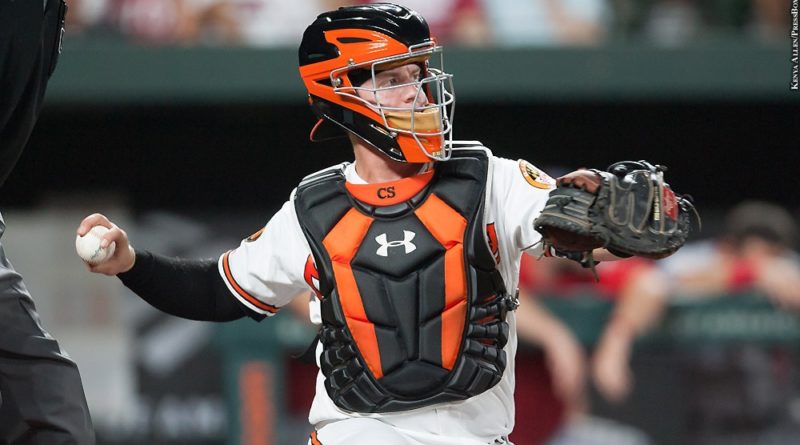
Maybe I’m just a sucker for anyone named the general manager for my team of choice. So count me as one who’s not perplexed or bothered by two of the best hitters this spring being optioned out to Triple-A Norfolk. Yes, I am talking about outfielder Austin Hays and catcher Chance Sisco.
Sure, in a season that figures to suck in the won-loss column, it would have made for a bit of whimsical interlude to a downer summer to have had two possible bright spots in the lineup night in and night out.
And yes, I get that in this day and age, it’s easy to be cynical when we see infielders Vladimir Guerrero Jr. and Nick Senzel sent down by the Toronto Blue Jays and Cincinnati Reds, respectively, with their teams saying they aren’t ready yet.
Two other big-time prospects, Chicago White Sox outfielder Eloy Jimenez and San Diego Padres infielder Fernando Tatis Jr., will begin in the major leagues. In the case of Jimenez, the ChiSox decided to extend him early and pay through his arbitration years along with one or two free-agent years. But Tatis is coming up with no such assurances in place and his financial clock is ticking.
But in the case of Hays and Sisco, I am going to defer to Elias and the process he saw work so well in Houston. That process rings the bell first and foremost at the D word: development.
We heard manager Brandon Hyde mention it so much in his introductory presser, and then this spring we heard it more and more. What I’ll look forward to finding out as I spend more time around Elias and Hyde is what the word truly means to them.
In the case of Hays, it seems pretty straightforward. Here is a player who suffered two injuries that punctured any chance of a successful season in 2018. His development was halted by the time he missed in spring training due to a shoulder strain, and just at the time when his shoulder began to get better, he began to have ankle problems. Hays was shut down in late May and didn’t play again until July 28.
So despite Hays’ incredibly gaudy numbers this spring (.351/.385/.892), Elias, unlike his predecessor, Dan Duquette, opted to not rush a player who hasn’t had one at-bat above Triple-A. Unfortunately, his 2019 season has been interrupted by a mild sprain in his left thumb he hurt while diving back into a base.
In the case of Sisco, it’s a bit different. Sisco plowed through the Orioles’ system one step at a time from 2013-2016 due to the strength of his bat; he’s a career .306 career hitter in the minor leagues. But Sisco’s first go-round in Triple-A in 2017 was an off year offensively; he batted just .267 and scored and knocked in 47 runs. His on-base percentage was for him a rather pedestrian .340. Of course, anyone could see his rookie season in 2018 was beyond awful.
Here’s the way I piece it together: The higher Sisco climbed the ladder, the more the organization really started to apply some pressure for him to polish up his act defensively. It seems possible that as he focused more and more on his defense — and it did seem improved in the early going in the big leagues last season — the more his offense suffered. Rumors were his pitchers didn’t love throwing to him, and then it just all fell apart.
However, when we heard of Sisco’s early home run binge in spring training, it was easy to draw the conclusion that he was a lock to make the team, especially given his competition at the position. That is until the time came for Elias and manager Brandon Hyde to think of what was best for the player. That’s when the decision was made to help Sisco maximize his talents by refining them away from the rigors of the major leagues.
The inverse of this was how a Duquette-led Orioles team handled one-time wunderkind prospect Kevin Gausman when it drafted him out of LSU in June 2012. The mindset when they drafted Gausman was that they needed a hard-throwing, potentially dominant starter at the top of the rotation in short order. Remember, Chris Tillman hadn’t really been much of a proven commodity.
Gausman was first called up to the big leagues in May 2013, less than a year after he was drafted, and he was shuffled between the majors and minors from 2013-2015. There were a lot of reasons Gausman never turned into the pitcher the Orioles hoped he’d be, but highest on the list, in my estimation, was never finishing off his development.
The Orioles chose to travel down the road of asking Gausman to be what they needed him to be, not allowing the process of development to play itself out.
As spring training gives way to the regular season ahead — one in which the club will be hard-pressed not to lose 100-plus games again — one of the positives during such a time is that there’s absolutely no rush to bring up players who aren’t truly ready for the higher stakes of big league life.
Photo Credit: Kenya Allen/PressBox