
Jesse Minter is the 16th head coach in Baltimore Colts-Baltimore Ravens history. I’d say “Baltimore NFL history,” but technically the first few years of the original Colts came in the AAFC, which later merged into the NFL. But you knew that.
So before Minter begins what Ravens fans hope will be a long, successful tenure as head coach, let’s look back on the 15 that came before him with “The 15 Baltimore Football Coaches.” Apologies to “Baltimore” Stars head coach Jim Mora and Baltimore Stallions coach Don Matthews. I was hoping the math would work out to include them, but we had just a few too many in Colts and Ravens history to make the list. The list is chronological.
1. Cecil Isbell (1947-1949)
When you think of the great quarterbacks in Packers history, it would be easy to forget (or not be remotely aware of) Isbell. But he was an All-Pro in all five of his professional seasons. As the first coach of the original Colts, he holds the distinction of being the first pro coach of Hall of Famer Y.A. Tittle. But he went just 9-22 before resigning in the midst of his third season.
2. Walter Driskill (1949)
Driskill was the general manager of the Colts when Isbell resigned and took over for the rest of the season, going 1-7 as the interim coach. He had served as an assistant under Jim Tatum at Maryland in 1947 and replaced Tatum as the school’s athletic director that year. He was the Colts’ general manager from 1948 until the team folded in 1950.
3. Clem Crowe (1950)
A former head coach of the Bills and at Iowa, Crowe was hired to coach the Colts in their inaugural season after merging into the NFL. It didn’t go well. They went 1-11 in 1950 before folding as a franchise. In his book “Fatso,” Art Donovan said of Crowe “this sonofabitch was crazy, and my first training camp immediately became one of the worst experiences of my life.”
4. Keith Molesworth (1953)
The former Bears quarterback started his coaching career at Navy in the 1930s and worked his way up to his only head coaching job during the modern Colts’ inaugural season. He went just 3-9 but moved to the front office and stayed with the organization until his death in 1966.
5. Weeb Ewbank (1954-1962)
The Colts’ next head coach led the franchise to prominence, guiding the Colts to their first winning record in 1957 and then their first NFL championship a year later, beating the Giants in what is known as “The Greatest Game Ever Played.” He led them to another title a year later in a championship game hosted at Memorial Stadium.
In “Fatso,” Donovan credited Ewbank with making him a Hall of Famer but also said “Weeb was a screwball who held insane grudges, concentrated too much on what I considered the unimportant aspects of the game, thought he was smarter than God, and deep down inside was one mean sonofabitch.” He later led the Jets to a Super Bowl III upset win against the Colts and was inducted into the Pro Football Hall of Fame in 1978.
6. Don Shula (1963-1969)
Perhaps the greatest coach in Baltimore football history, Shula never actually won a championship with the Colts. He went 71-23-4 (a .755 win percentage) but lost the 1964 championship game to the Browns and Super Bowl III to the Jets. He controversially departed after 1969 amid a spat with owner Carroll Rosenbloom and went on to win two Super Bowls with the Dolphins. He was inducted into the Pro Football Hall of Fame in 1997 and remains the winningest coach in league history.
7. Don McCafferty (1970-1972)
After 11 years on Ewbank and Shula’s staffs, McCafferty was promoted following Shula’s departure. He led the Colts to a Super Bowl V win against the Cowboys in his first season and guided them back to the AFC championship game a year later. But after Rosenbloom traded the franchise to Robert Irsay, the Colts got off to a 1-4 start in 1972 and new general manager Joe Thomas wanted Johnny Unitas benched for Marty Domres. McCafferty refused and Thomas fired him. He coached the Lions for one season before his untimely death at 53 due to a heart attack.
8. John Sandusky (1972)
In the midst of his 14th season as an assistant with the franchise, Sandusky was chosen to replace McCafferty. He benched Unitas for Domres, but the team still went just 4-5 the rest of his only season as head coach. You may be familiar with his son Gerry, the Ravens’ play-by-play voice since 2006.
9. Howard Schnellenberger (1973-1974)
Thomas hired one of Shula’s lieutenants in Miami to replace Sandusky in 1973. Schnellenberger went 4-10 in his first season and lost his first three games in 1974. During the second half of the third game, Irsay went to the sideline to ask Schnellenberger when he might bench Domres in favor of Bert Jones. Schnellenberger gave what The New York Times described as a “tart reply,” and Irsay fired him. Schnellenberger later won 158 games as a college coach with stints at Miami, Louisville, Oklahoma and Florida Atlantic.
10. Joe Thomas (1974)
After firing Schnellenberger, Irsay quickly informed his general manager that he would be taking over as coach. Thomas went just 2-9 the rest of the season but stayed on as GM for another two seasons.
11. Ted Marchibroda (1975-1979, 1996-1998)
Marchibroda had a fascinating coaching career. He guided the Colts to a miraculous turnaround in 1975 and the first of three straight AFC East titles. But he resigned before the 1976 regular season because Irsay was verbally abusing players and he was constantly fighting with Thomas. He was only rehired because his assistants and players threatened to boycott. He led the Colts to two more division titles the next two years (including Jones’ 1976 MVP season) but experienced only playoff heartbreak, including the Raiders’ famous “Ghost to the Post” in 1977.
Marchibroda was fired after the 1979 season but worked his way back to being a head coach in 1992 … with the Indianapolis Colts! He led the Colts to the AFC championship game in 1995 but was let go after the season. He was then selected to be the first head coach of the Ravens. Those early Ravens teams went 16-31-1 in his three seasons at the helm, but Marchibroda helped to bridge the gap between the franchises.
12. Mike McCormack (1980-1981)
A Hall of Fame offensive lineman who spent most of his playing career with the Browns, McCormack replaced Marchibroda after 1979 and struggled. The Colts went 9-23 during his forgettable two seasons.
13. Frank Kush (1982-1983)
A College Football Hall of Famer for his wild success at Arizona State, Kush was controversial for his intense, if not abusive style. He was passed over for the job when it went to McCormack but then was chosen to replace him. The 1982 team went winless in a strike-shortened season. As rumors swirled about the future of the franchise, Kush pushed for a move to Phoenix. He spent one more season as coach after the move to Indianapolis.
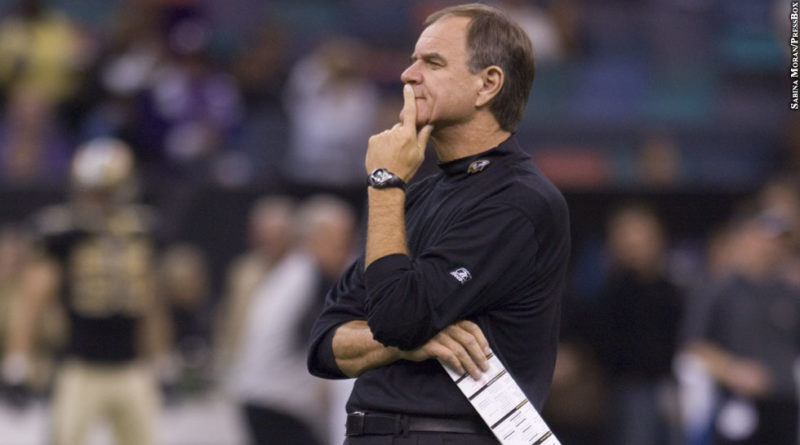
14. Brian Billick (1999-2007)
Billick was hired as a guru whose Vikings teams were thrilling during his time as offensive coordinator. He was never able to translate that to Baltimore. Instead, his teams set a defensive standard that included a record-setting run to the Super Bowl XXXV title. The future Ring of Honor inductee went 80-64 in nine seasons, reaching the playoffs four times before being dismissed after a disappointing 2007 season.
15. John Harbaugh (2008-2025)
Completely unheralded when the Ravens plucked him from the Eagles’ staff as special teams coordinator, Harbaugh became the longest-tenured coach (or manager) in Baltimore sports history. He finished his Ravens tenure as the 14th-winningest coach in NFL history, going 180-113 with 12 playoff appearances, including the Super Bowl XLVII title.
Photo Credit: Sabina Moran/PressBox
Issue 297: February / March 2026
Originally published Feb. 18, 2026