
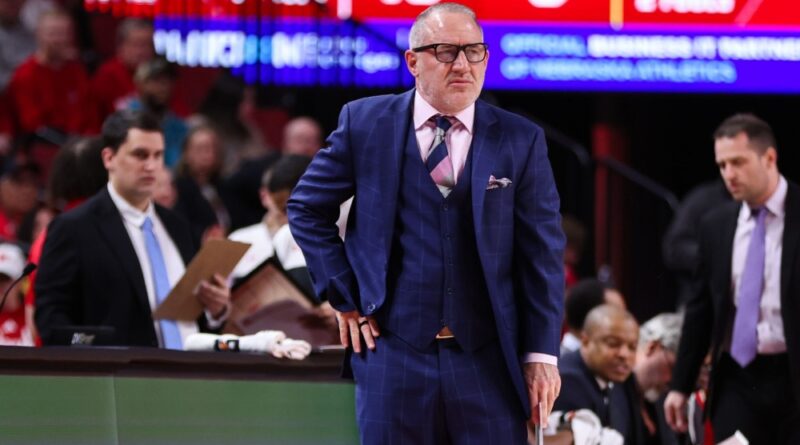
The Maryland men’s basketball team’s season is finally over.
The Terps fell to Iowa, 75-64, in the second round of the Big Ten tournament on Wednesday, March 11, officially ending a tumultuous campaign. Maryland defeated Oregon, 70-60, the day before in its first tournament matchup.
The Terps finished 12-21 overall and 4-16 in Big Ten play. It marked the program’s first 20-loss season since 1988, when the Terps went 9-20 overall and 1-13 in the ACC.
With the 2025-26 season now in the rearview mirror, Buzz Williams & Co. must figure out how to bounce back and improve their roster.
Williams is no stranger to turning programs around. He posted an 11-22 record in his first season at Virginia Tech in 2014-15. The Hokies then won 20-plus games each season from 2015-2019 and made three NCAA Tournament appearances.
Williams landed at Texas A&M after leaving Virginia Tech. His team went 16-14 in his first season at A&M in 2019-20 and played just 18 games a year later due to COVID-19. After that, Williams won 21 or more games in each of his final four seasons.
Now entering his second year in College Park — and his first with a full offseason — Williams will aim to engineer another turnaround.
Maryland currently holds the No. 7 recruiting class in the nation, according to 247Sports. The group is headlined by five-star forward and Silver Spring native Baba Oladotun. Joining him are four-star recruits Kaden House (guard) and Adama Tambedou (forward) and three-star forward Austin Brown.
This promising freshman class alone gives Maryland fans reason to believe the 2025-26 season won’t repeat itself. Still, the roster will require more work. The transfer portal, which opens next month, will be crucial for adding experience and refining the rotation.
Here are three roles Maryland could target:
Point Guard
Maryland has several guards with eligibility remaining, but none fits the mold of a traditional lead guard. No Terrapin averaged more than 3.0 assists per game in 2025-26. Graduate transfer Diggy Coit led the team with 2.8 assists, though he functioned more as a score-first option.
Freshmen Darius Adams and Guillermo Del Pino also logged minutes at point guard, but neither stood out for their playmaking. Overall, Maryland ranked last in the Big Ten in assists at 10.5 per game.
Although assists aren’t the sole measure of point guard play, the Terps lacked a consistent facilitator who could drive and create for themselves and others. Addressing that deficiency will be critical.
Big Man
Maryland has a strong lineage of big men — Diamond Stone, Bruno Fernando and Derik Queen among them recently.
But after Pharrel Payne suffered a season-ending injury in December, the Terps struggled to find a dominant presence inside. Seniors Collin Metcalf, Elijah Saunders and Solomon Washington rotated through the role, but Maryland needs more size and strength to compete in the Big Ten.
It remains uncertain whether Payne will return next season. Even if he does, the roster will benefit from adding another impact big man to pair with him.
Three-Point Specialist
Saunders was Maryland’s most efficient 3-point shooter, hitting 41.1 percent of his shots from beyond the arc. Coit made the most threes on the team (71). Both will need to be replaced.
The Terps finished 16th in the conference in 3-point percentage at 31.7. The best mark in the league is UCLA’s 38.2 percent.
Three-point shooting was a clear weakness. Williams emphasized getting to the free-throw line and winning the rebounding battle to compensate, but a proven shooter, whether off the bench or in the starting lineup, could significantly open up the offense.
Photo Credit: Courtesy of Maryland Athletics