
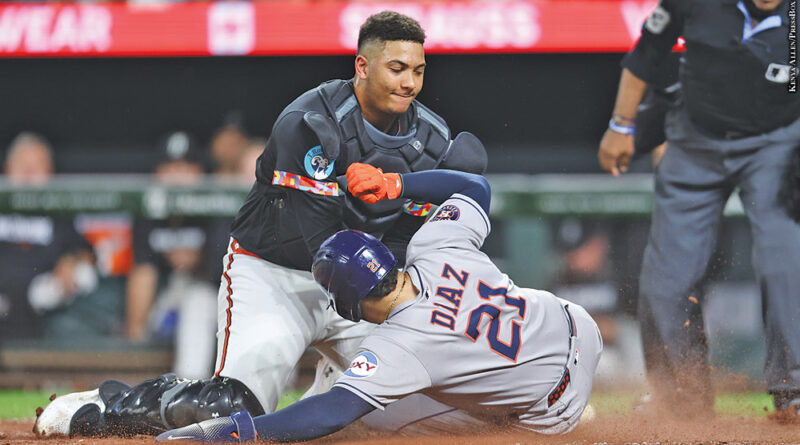
Long before he became the cornerstone of the Baltimore Orioles’ international pipeline, catcher Samuel Basallo was a teenager learning how to live away from his family.
Growing up in the Dominican Republic, Basallo dreamed of reaching the major leagues years before he was eligible to sign a contract.
At 12 years old, he left home to join renowned trainer Ivan Noboa’s Baseball Dreams Academy, waking up at 4:30 a.m. every day for two-a-day workouts. But his grueling training regimen wasn’t the hard part.
The separation from his loved ones was — a challenge he says never truly gets easier.
That distance instilled in him the patience, focus and humility that fueled his ascent into one of baseball’s top prospects. Now, it’s helping reshape how future generations of international prospects see Baltimore.
“It’s an organization that is going to get the best out of you,” Basallo, now 21, said through interpreter Brandon Quinones. “It’s going to support you. Everyone is going to care about you and want what’s best for you, whether you’re the No. 1 prospect or not. The organization is always going to be worried about you.”
Building The Program
Basallo’s rise is no coincidence.
It’s the product of a deliberate overhaul within the Orioles’ international scouting operation, led by vice president of international scouting and operations Koby Perez.
Before Perez was hired in January 2019, Baltimore was largely an afterthought in the international market. The organization invested sparingly in Latin America, leaving many top prospects to sign elsewhere and limiting the team’s ability to build a pipeline of elite young talent.
Scouts were few, and the franchise lacked the infrastructure that other clubs used to attract international players. As a result, international prospects rarely considered Baltimore a serious destination.
“Agents weren’t thinking about the Orioles just because they knew that they weren’t investing there,” Perez said. “But I think just showing face and my previous experience with other clubs vouching for what we’re trying to do here was essential in jump-starting the program.”
Prior to joining the Orioles, Perez spent more than a decade honing his expertise in Latin American scouting with Philadelphia and Cleveland. This not only gave him a wealth of experience, but also helped him develop the relationships and evaluation skills that would be foundational for Baltimore’s pivot.
Still, Perez knew increased investment alone wouldn’t be enough. Rebuilding the organization’s presence meant building the right staff. He set out to assemble a diverse group of scouts, blending experienced veterans with younger evaluators and personnel who could integrate analytics into traditional scouting.
Upon his arrival, Perez inherited Luis Noel, a former pitcher already with the organization.
Michael Cruz, who was working for MLB at the time, was Perez’s first addition — a young scout he had recommended for a junior college baseball opportunity in the U.S. Cruz was paired with Rafael Belén, a veteran scout whose résumé included stints as a supervisor with the Texas Rangers and Houston Astros and the signing of major leaguers like Teoscar Hernández.
Perez rounded out his hires in 2019 with former minor leaguer Francisco Rosario, who had played a huge role in Seattle’s signing of 2022 American League Rookie of the Year Julio Rodríguez.
In 2020, Gerardo Cabrera joined Perez’s staff from the Mets, where he had signed talents like Ronny Mauricio and Francisco Alvarez. Venezuelan scouts Yfrain Linares, Francisco Veracierto, Christian Casanova and Victor Prato rounded out the group, supported on the operational side by Maria Arellano and Scarlett Blanco.
For Perez and his staff, evaluating international talent is as much about projection as it is present ability. Scouts often identify players as young as 13 or 14, prioritizing instincts, competitiveness and how a player carries himself over raw production.
The Orioles place heavy emphasis on “baseball savvy” — being unafraid of the moment, consistently finding the barrel and refusing to back down against older competition, according to Perez.
From there, the organization blends traditional scouting with data, using tools like TrackMan and K-Vest to track performance and build a database that informs future decisions. Understanding the person behind the player is just as important. So on trips abroad, scouts and front office members often meet with prospects’ families to evaluate character and makeup.
Perez said the team’s mix of youth, experience and local ties brought immediate credibility to the Orioles’ efforts and allowed them to rapidly re-enter the market.
“You can get the rug pulled from under you if you don’t act quickly,” Perez said. “Not only us, but every organization understands the importance of trying to get in there early to reap those benefits.”
Opening The Door
Basallo’s path to Baltimore reflects the organization’s shift in international scouting.
Perez first saw him around age 13 or 14 at a workout in the Dominican Republic — one the Orioles hadn’t even attended to scout him.
Most of the team contingents in attendance were there for coveted prospect Jasson Domínguez, but Basallo’s poise and hitting ability stood out enough to land him on what scouts call a “pocket follow,” a player worth tracking even if he wasn’t the primary target.
After Perez revamped his staff, he revisited that list. From there, the Orioles kept eyes on Basallo to monitor the development of his instincts and makeup. Baltimore inked Basallo to a then-franchise record bonus of $1.3 million as an international free agent once he was eligible to sign in 2021.
In the years since, he has grown into one of the team’s most promising young players. He has developed into a middle-of-the-order threat with a towering presence — 6-foot-4 and 250 pounds — that matches his production. But Perez stresses that Basallo’s physical tools aren’t the most impressive part of his game. It’s his cerebral nature.
Perez said since the day he met Basallo, all he has talked about is “being the best.” Just as much as winning a World Series, Basallo’s main goal is simply to improve each day and find ways to learn from his mistakes.
“No one has tried to change anything about me,” Basallo said. “I’ve always done things well in terms of my work, so the organization never forced me to do anything because that’s what I was already doing. The organization has only focused on hard work and teaching me the little things that we’re still learning.”
Basallo’s success hasn’t just been measured in gaudy numbers or lucrative contracts. It’s also about the message he sends to the next generation of international prospects.
“I was one of the first ones who opened the door for them,” Basallo said. “Every case is different. Everyone has to, at the end of the day, look out for what makes the most sense for them. There are a lot of different things that go into that. For me personally, being able to be here made the most sense for me and my family. And I think what they’ve been investing internationally has been great for everyone involved.”
Photo Credit: Kenya Allen/PressBox
Originally published April 15, 2026