

Last spring, Patrick Krivosh realized his sporting destiny.
Now a senior at Calvert Hall, Krivosh had played a variety of sports but had yet to find one that so perfectly matched his natural relentlessness with the game itself.
Then Krivosh took the advice of his coaches and friends on the Calvert Hall wrestling team and joined the school’s rugby team, and it was as if he had found his soul mate. The game was perfect for him. He loved everything about it, and it now consumes him more than a year later.
“It’s just really been a big change in my life,” Krivosh said. “Now it’s something that I couldn’t imagine my life without because it just takes up so much of my time, and I just put so much time and hard work into it.”
Krivosh quit football and wrestling at Calvert Hall to focus on rugby, and in the fall he will play the sport at Mount St. Mary’s University.
“It’s important to have something to work toward and a purpose because, without that, your life really doesn’t have any direction,” he said. “That’s something I feel like I was kind of missing in my life. I was just kind of going through the motions of life. But rugby has given me that.”
While rugby is not played on the varsity level in Maryland’s public high schools, there are a handful of private schools that offer the sport.
Calvert Hall is one of four schools that play rugby in the Maryland Interscholastic Athletic Association, along with nine-time MIAA champion Loyola Blakefield, Mount Saint Joseph and Archbishop Spalding, which has won the last two league titles with victories against Calvert Hall in the championship game.
The MIAA has sanctioned rugby since 2007, and the sport has gradually become more popular ever since.
The season runs from the end of February until mid-May when the league crowns its champion following a semifinal round and the championship game.
MIAA teams typically carry between 25 and 30 players. They fill out their schedules of roughly 12 games with nonconference opponents from Washington, D.C., Virginia, Pennsylvania, New Jersey and Delaware.
The sport lives up to its reputation. It’s a physical battle of wills that often features high-speed collisions among players not wearing helmets or pads. It requires a certain degree of athleticism and toughness.
“In practice and in games, there is blood, sweat and tears. That’s no joke. You are going to bleed with your brothers,” said Chad Newcomb, a former rugby captain for Salisbury University who has coached at Spalding for 18 years. “You’re going to sweat. You’re going to hurt. But sometimes it’s a beautiful thing to get beaten up for a good cause. And I mean that in the most respectful way.”
Rugby is a far more technical game than it gets credit for, and it’s not as recklessly violent as it might seem to some, Calvert Hall head coach J.R. Elliott explained.
Teams of 15 players a side compete on a rectangular-shaped field known as a pitch. Players run with an oval-shaped ball, and the object is to score more points than the other team. Players cannot pass the ball forward — just backward and laterally — or block. If a player is tackled they must let go of the ball, and the loose ball may be picked up or contested if multiple players converge at the site of the tackle. Gaining possession is the primary defensive objective. There are no downs or possession clock.
Points are scored by grounding the ball in the in-goal area between the goal line and dead-ball line, which is worth five points and carries with it an additional two-point conversion kick, or with a penalty kick or drop goal, which are worth three points each.
“Rugby’s grown so much in the technical aspect,” Elliott said. “Our coaches, when I was playing at Calvert Hall, were like, ‘Run through them. Hit them hard.’ Now, it’s way more technical in terms of moving your head and wrapping through a tackle and moving into space to create more options versus just running through someone. Of course, that’s part of the game in a way. But I feel the game has evolved a lot.”
And that, in turn, has made it safer, Elliott said.
Newcomb feels the beauty of rugby is that anyone can play it, and there is a role and position for anyone, regardless of size and skill.
“In four years at Spalding, they might have never touched a football. But in a rugby game, they’ll touch the ball eight times and make 12 tackles and they feel like giants,” he said. “That’s amazing to me. … It was just extremely important to me to make sure that rugby, especially rugby at Spalding, is a family atmosphere. We look after one another.”
Reid Gerber felt that community bond right away when he joined the rugby team at Spalding as a freshman. He had been a soccer player prior to that.
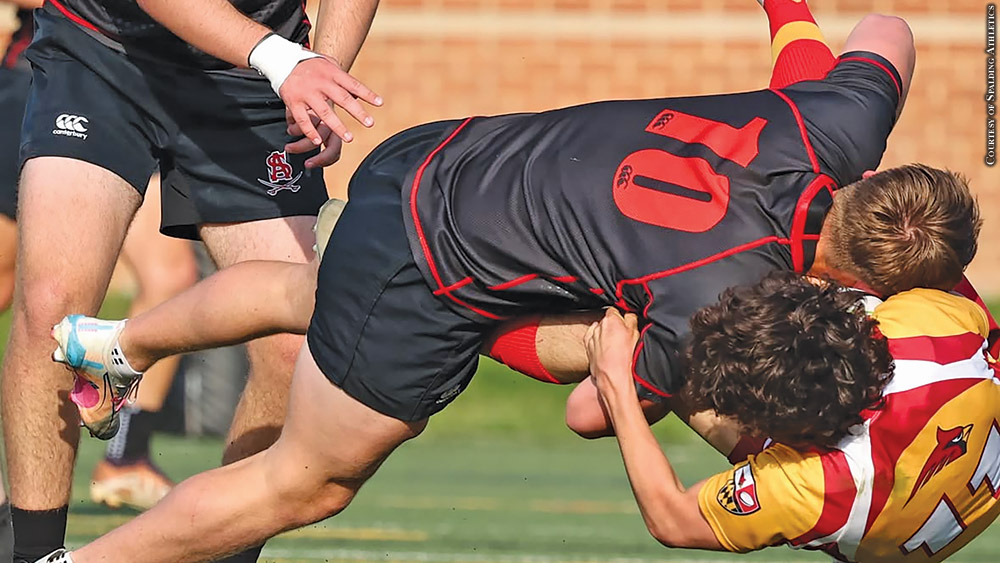
Gerber was quickly drawn to the physicality and the intensity of rugby. He liked that the game transitioned quickly from defense to offense, and he felt it allowed him to be creative and play with a certain sense of freedom.
After learning the game and developing as a player very quickly, Gerber, now a senior at Spalding, will play rugby in college later this year at Navy, which has one of the top programs in the country.
He will follow in the footsteps of his older brother, Aidan, who played rugby at Spalding and is now a junior flanker on Navy’s team.
“I always tell people that playing rugby was probably the best decision I ever made,” Reid Gerber said. “Playing soccer, I had no idea what I was going to do. I didn’t even know if I was going to play in college or what college I was going to. But, once rugby came along, it brought me to the [Naval] Academy. It’s done so much for me, which is great.”
Photo Credit: Courtesy of Spalding Athletics
Originally published April 15, 2026