
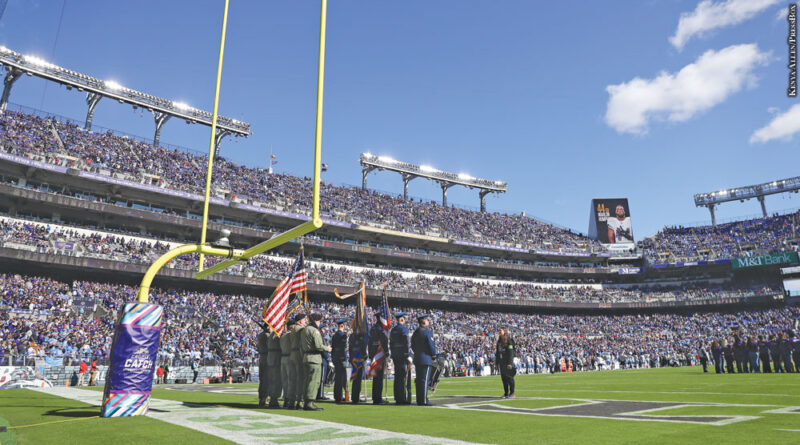
With the 2031 Men’s Rugby World Cup and 2033 Women’s Rugby World Cup on the horizon, the international rugby community will have its attention fixated on M&T Bank Stadium when the Springboks of South Africa and the All Blacks of New Zealand face off on Sept. 12.
The match, the finale of four “Rugby’s Greatest Rivalry” contests between the two sides occurring in August and September, pits the top-ranked South African team against the No. 2 New Zealanders, as rated by World Rugby.
Baltimore is one of 27 cities vying to host international rugby matches when the 2031 and 2033 World Cups come stateside. Hosting a match of this magnitude gives Charm City a chance to display its ability to accommodate rugby at the highest level.
“It puts us on the map as a venue that can support a rugby match of this scale,” Ravens senior vice president of stadium operations Rich Tamayo said.
The matchup being the finale of the “Rugby’s Greatest Rivalry” series only raises the stakes.
“There is a lot of faith and trust that we’re going to give this game its due,” Tamayo said.
The teams will be playing before a packed house, as the Ravens anticipate a sellout for the event, which will bring an influx of rugby fans from around the world to Baltimore.
Tickets are available on SeatGeek starting at about $160. Ticket sales have come out of 48 of 50 U.S. states as well as Washington, D.C., with more than 7,400 tickets having been purchased internationally, according to Ravens vice president of public relations Patrick Gleason.
The match, therefore, presents not just an opportunity for the Ravens and their 71,000-seat stadium, but also for the city as a whole, a prospect that excites Visit Baltimore CEO Kireem Swinton.
“We’re [going to] be able to showcase Baltimore in a very different way with rugby sports fans that’ll be coming into town,” Swinton said.
Swinton hopes that the city can deliver positive experiences to individuals who are traveling to Baltimore for the match.
“For many of them, we realize this might be a once-in-a-lifetime opportunity … to see these two teams play against each other,” he said. “We want to make sure that we dial into that as Baltimoreans and show them that this is a place that they [can] continue to have experiences like that no matter whether it’s this sporting event or any other.”
The added benefit is the economic impact to Baltimore itself. Swinton noted that such tourism “helps our hotels, helps our small businesses [and] helps our restaurants.”
“When people are coming in, they’re enjoying an event like this,” he said. “It just helps us for future years because we build more ambassadors to tell people the true story about how great Baltimore really is.”
While many will travel to Baltimore for the event, there will be a strong local presence as well. Baltimore Chesapeake Rugby Football Club president Blake Carroll has tickets to the game, and he said a lot of his program’s players and alumni do as well. Carroll believes Baltimore has a thriving rugby scene, making the city a logical location for the match.
There are numerous high school and college programs in the area. There are also several men’s and women’s club teams, including Carroll’s club, BCRFC, and the Baltimore Flamingos Rugby Football Club, which fields LGBTQ+ teams.
Additionally, BCRFC hosts an annual rugby sevens tournament, the “Rites of Summer,” in which Carroll estimates 400 to 500 players participate. This year’s tournament will take place on June 27 at Western Regional Park in Woodbine.
“There’s a big storied history of rugby in the area,” Carroll said.
Loyola Blakefield rugby coach Nate Brady noted another driving factor in “Rugby’s Greatest Rivalry” coming to Baltimore: the city’s proximity to other major coastal hubs.
“Rugby fans from the entire mid-Atlantic all the way up into the Northeast can come down very easily for a big weekend of rugby,” Brady said.
Brady, whose team won the MIAA this spring, said many of his players and their families have bought tickets to the match.
As for the matchup between the Springboks and All Blacks, it sells itself. Carroll described it as “two of the titans of the game with a very rich history of playing each other, they’ve been battling each other for decades and decades.”
Notably, the sides faced off in the final of the 2023 World Cup, won by South Africa by a score of 12-11. Combined, the countries have won the last five World Cups and seven overall.
Since the 2023 World Cup, South Africa has taken three out of four matches, but New Zealand still holds the all-time series lead, 62-42 with four draws. With three matches in the weeks leading up to the series finale at M&T Bank Stadium, the teams will be as familiar with each other as ever.
Brady said this is “one of those matches where you don’t always know who’s [going to] win but you know it’s [going to] be a fantastic match and most likely going to be … just a one-score difference.”
Beyond the match itself, the Ravens are working to enhance the experience as a whole for fans.
“Get ready to be blown away,” Tamayo said.
Another element of excitement will surely come with the All Blacks’ famous pregame ritual — the haka. New Zealand performs the Māori dance as a challenge to opponents before every rugby match.
Brady, who has previously attended an All Blacks match, expects it to hype up the crowd.
“To see it in person is really something else, to celebrate their culture and also what it means to rugby as a whole,” he said. “A lot of people don’t know much about rugby, but most people know something about the haka.”
Photo Credit: Kenya Allen/PressBox
Originally published June 24, 2026
