
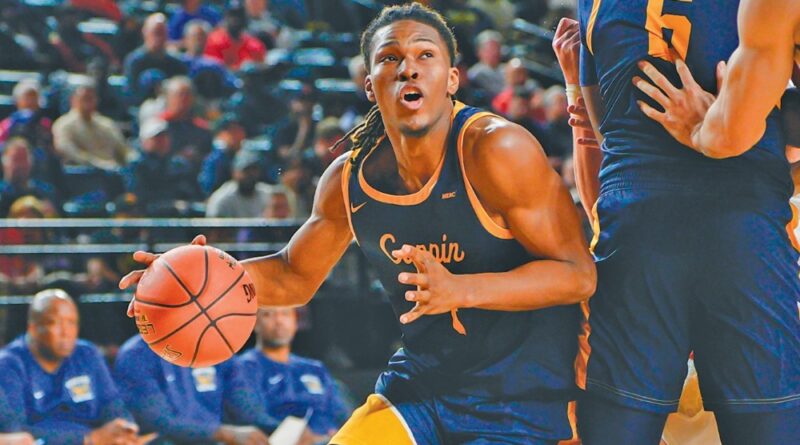
Coppin State men’s basketball senior Hussain Williams recently chatted with PressBox about beginning at Radford as a regular student, restarting his hoops career at the junior college level and more. The 6-foot-5, 205-pound guard averaged 7.3 points and 2.4 rebounds per game for the Eagles in 2025-26. Williams is a native of Lynchburg, Va., and graduate of Heritage High School.
PressBox: How did you first become interested in basketball?
Hussain Williams: I’ve been involved in sports my whole life. My parents, [Muhammad and Aliya], started having me play football, soccer, baseball, basketball since I was 4. I played football and basketball as my main two sports up until eighth grade. Going into high school, I wanted to focus on just one. I focused on basketball. I ended up making here. I played two years of high school basketball in 11th and 12th grade years, then stopped playing and went to Radford as a regular student, then went two years of JUCO and then now I’m here. I just fell in love with this sport, and I’m glad I chose it.
PB: Who was the biggest influence on your game growing up?
HW: Besides my dad, I would say Kobe Bryant. He’s a role model. I try to model my game after him and look at a lot of his stuff offensively, defensively, his mentality.
PB: Why did you initially attend Radford as a regular student?
HW: Out of high school, I had two or three JUCO offers, but I wasn’t really worried about those. I just wanted to go to school. The goal originally was to try to walk on, but they already had spots filled, so I just thought it was going to be over for me.
PB: Why did you pick up the basketball again?
HW: After the spring semester at Radford, I knew a coach at JUCO, so I asked him if I could try out for a few days over the summer. It was rough at first. He wasn’t really liking me. I had a lot to improve on. I actually missed the first semester [at CCBC Dundalk] because of my grades from Radford. I wasn’t really doing everything I had to do in the classroom, so I had to pick that back up. That semester at JUCO really helped me improve my game a lot while the season was going on. When January came for the spring semester, I just really picked [my game] up from all the work I had put in. I got the offer from Coppin State actually my first semester of JUCO. I couldn’t even come [to Coppin] because of my grades at Radford, so I had to do another year of JUCO and get my associate degree. I just kept putting in the work on and off the court and eventually still end up coming here.
PB: What was the experience like at CCBC Dundalk?
HW: JUCO is tough. It takes a toll on your brain. It takes a toll on your body. You have to really be tough. It’s dogs in JUCO. How I mentioned my grades were holding me back from going to where I needed to go, there are a lot of situations [like that] in JUCO. They’re trying to make their way out just like how I was. We didn’t have a trainer. It was literally just the 12 people on the team and the three coaches. Our coach was everything — our trainer, our strength coach, our head coach. He was doing everything for us. We had a rubber court. Our home court was a rubber court, so we had no grip during the game. … Slipping and sliding everywhere, couldn’t really play defense how you wanted to, cross the ball over, stuff like that. It was a struggle, but you’ve got to work with what you’ve got, and that’s what we did. Doing that got me here.
PB: What would be your advice to young players contemplating the JUCO route?
HW: Honestly, I would push the JUCO route, especially nowadays with the transfer portal. A lot of coaches are looking for experienced players, older players. Unless you’re a five-star or a four-star, it’s kind of hard to just go straight to college and start working — D-I, D-II or D-III, really. I would push JUCO because JUCO kind of gives you a second chance, I would say. If you do what you have to do at JUCO, you can have more offers than you [had] out of high school. JUCO has dogs, so if you can compete at that level, you can compete really anywhere.
PB: Why did you choose to go to Coppin?
HW: I was getting recruited for basically a whole year and a half, maybe, so [the coaching staff] would keep in contact with me and my family also, which is a big deal to me — checking up on me all the time, even coming to practices, coming to games. They would [invite] me to come to games and some practices. They really showed a lot of interest in me. Other schools that I was talking to and were interested in me didn’t really show the same love and care that they did. It was just right to come here, and they still show the same love and care so I think I made the right decision.
PB: What’s the challenge academically of transferring twice in college?
HW: [I am majoring in] interdisciplinary studies, but I have minors in psychology and sociology. My original major was kinesiology at Radford, but Coppin doesn’t have that. It is hard to adjust [when transferring] because not every school’s the same, even the minor stuff like the apps we use to do our schoolwork. For instance, at Radford and CCBC Dundalk, it was easy for me to go into the apps and see Mondays, Tuesdays, Wednesdays, Thursdays, Fridays — everything I have to do on those days. But here at Coppin, we have Blackboard. I have to go search for it more than it just being in my face. That’s a little minor inconvenience, I would say, but if you want to do it you can do it still. The classrooms are way smaller, so I can have a relationship with my professor. They know my name. I know their name. They know my face. Back at Radford and CCBC Dundalk, it was bigger classes, so you really had to be on your P’s and Q’s if you wanted to be successful, so I like that.
PB: What’s your favorite thing about Coppin?
HW: The people. It’s an HBCU. I wasn’t used to HBCUs [prior to] last year, so the people. The campus isn’t really that big. … The small campus I like. Seeing the same faces, it’s nice to see smiles all the time. Everyone’s very supportive, and I like that.
PB: What went right during the Eagles’ four-game winning streak late last season?
HW: We found the camaraderie late. Once we found it, we knew what we needed to do. We knew where people were going to be on the court. We trusted each other. We didn’t really trust each other at the beginning. We started trusting each other because it only takes one time for the ball to bounce right and it just rolls downhill from there. Me, my teammates and everybody else that contributed to the four-game win streak, we found what we needed to do. We listened to the coach. We bought in. Hopefully we can start off the season like [that].
PB: Who’s your best friend on the team and what’s a story that underscores your friendship?
HW: I would have to say Baasil Saunders. Me and him are both Muslim, so we bond like that. Basically everything I do, he’s with me. Everything he does, I’m with him. We make sure we’re in the gym together. We make sure we do our schoolwork together. He comes to my house. He’s from Philadelphia, so I go to Philly with him sometimes. Me and him built a good bond outside of the court, and I’m glad I met him.
PB: What goals do you have for after basketball, whenever it ends?
HW: After basketball I hope to still be involved in sports. I want to be either an athletic trainer, a strength coach, a head coach or an assistant coach to still be involved in the sport some type of way. Or even if it’s not basketball, just be involved in any sport because sports have been my whole life. I don’t really want anything to change even after I’m done playing.
Photo Credit: Tim Rice/Coppin State Athletics