
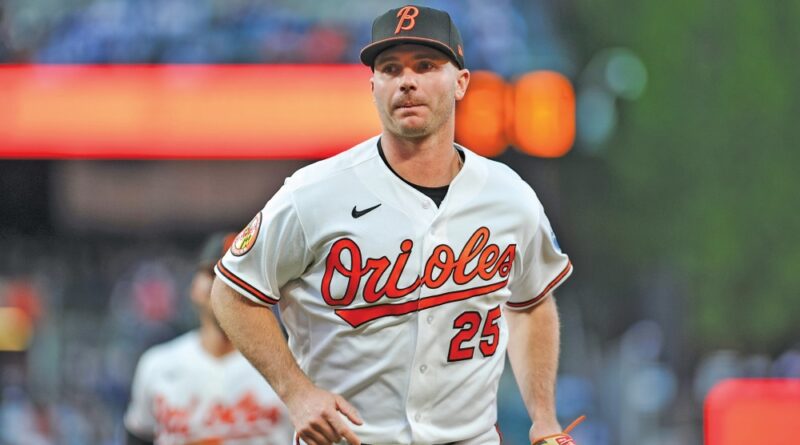
When the Baltimore Orioles signed first baseman Pete Alonso to one of the largest deals in franchise history, a five-year, $155 million contract, they weren’t just buying a premier middle-of-the-order bat.
They were adding a presence.
Along with his lucrative deal came a leadership role in a clubhouse filled with loads of potential and high expectations. The appeal wasn’t simply the opportunity to add a big bat. Baltimore valued everything Alonso could bring to the organization — including the part that couldn’t be measured in home runs or RBIs.
“There’s a lot of comfort and peace of mind in that, where it’s like, ‘Hey, we believe in you, not just from a player’s side, but what you bring as a personality and teammate,'” Alonso said.
Nine months later, the Orioles are coming off a 79-82 season that saw them miss the playoffs for a second straight year. Alonso knows better than anyone that Baltimore underperformed.
“What we put out there wasn’t good enough,” Alonso said. “The amount of talent in the room is off the charts, but the performance was lackluster for us over the course of time.”
While the Orioles struggled to find consistency as a team, the veteran slugger provided plenty of it himself.
In 2026, Alonso started all 161 of the Orioles’ games and hit .267/.363/.522. The 6-foot-3, 245-pound first baseman led the American League with 43 home runs and 113 RBIs. The soon-to-be 32-year-old also became the first player in major league history to win an RBI title in both leagues, adding to the NL RBI title he won with the Mets in 2022.
But the numbers only tell part of the story. For a team that never quite found its footing, Alonso rarely stopped producing. His impact increasingly extended beyond the batter’s box.
“To represent this organization, this city every day … I take an immense amount of pride in that,” Alonso said.
Long before the season reached its disappointing conclusion, Alonso had become a resource for teammates looking to improve their own games. He could regularly be found talking hitting with younger players, breaking down opposing pitchers or working through mechanical adjustments with teammates.
During one batting-practice session in August, Alonso took a left-handed stance to make a point to shortstop Gunnar Henderson about making contact. Later that night, after Alonso hit his 30th home run, he returned to the clubhouse and continued talking hitting with third baseman Christian Encarnacion-Strand.
That’s the kind of role Alonso envisioned when he arrived in Baltimore. His influence has been especially evident in how he has helped teammates prepare at the plate.
From third baseman Coby Mayo to second baseman Jeremiah Jackson, several teammates said the biggest steps in their development came from learning to game plan from Alonso.
“This is the first year when I’ve felt that presence, that leadership presence,” Mayo said. “He’s been great. We haven’t had a guy come into that type of role, making the biggest contract in our history. So it’s definitely a higher level of respect for Pete.”
Alonso takes that part of the game seriously. He has spent years studying how opposing pitchers attack him, identifying tendencies and adjusting from at-bat to at-bat. Now, with a clubhouse full of younger players still learning the nuances of hitting major league pitching, he has made a point of sharing that information.
The goal isn’t for teammates to copy him. It’s to give them another tool to develop their own approach.
“If you can have a good understanding of all the variables and how they’re trying to attack you, then that can lead to a lot of success,” Alonso said. “Sharing that information is good, and I hope people take to it and use it in their own way.”
Alonso’s influence hasn’t been limited to what he can teach teammates about hitting. When the Orioles traded catcher Adley Rutschman to the division rival Boston Red Sox at the trade deadline, Alonso found himself helping the clubhouse navigate something far more mentally taxing than a mechanical adjustment or a game plan.
Rutschman had been a face of the franchise and a foundational piece of the Orioles’ resurgence from 2022-2024. His departure dampened the mood in the clubhouse for a team already struggling to stay afloat.
Alonso didn’t try to pretend otherwise. That’s why he was quick to address the team after the transaction to acknowledge what Rutschman meant to Baltimore while also emphasizing the responsibility that remained for the players still in the clubhouse.
The Orioles had already lost a key fixture. So, Alonso made it his duty to help make sure they didn’t lose their perspective, too. Ultimately, Alonso’s brand of leadership isn’t about providing all the answers. It’s about giving teammates the tools and confidence to find their own.
Throughout the season, he encouraged teammates to figure out who they are for themselves. Younger players don’t heed his advice just to follow his blueprint. If anything, it’s the opposite. Alonso urges everyone to lean into what makes them unique.
“What that entails is just being the best you can on the field, between the lines, and the best teammate you can be every single day,” Alonso said.
That philosophy goes beyond the baseball diamond. Alonso made it a point to be the same person every day, whether things were going well or the results weren’t there. In a roller-coaster season, that steadiness became a crucial part of what he brought to the clubhouse.
For younger teammates, it provided another example of what Alonso believes leadership should look like — not trying to control a clubhouse, but setting a standard through one’s own actions.
“Pete was brought in to be Pete Alonso,” Orioles manager Craig Albernaz said.
For all the emphasis Alonso has placed on helping the Orioles around him, he knows leadership also means being willing to confront where the team needs to improve. As Albernaz and president of baseball operations Mike Elias stressed in the team’s end-of-season news conference, the path forward isn’t about reinventing the team. It’s about getting more out of what is already in the room.
Still, the Orioles can’t rely on potential alone. They have to turn it into production, and Alonso believes that starts with being honest about what went wrong and carrying those lessons into next season.
“We will be better, and I’ll be hell-bent on reflecting and providing input,” Alonso said.
After a season that fell short of expectations, Alonso appears ready to embrace his role. He came to Baltimore to be more than a middle-of-the-order bat. Now, with his first season in the organization behind him, he’s preparing to make sure the lessons from it aren’t wasted.
“We’re not where we want to be, but I want to win in the worst way,” Alonso said. “Regardless of the results this year, I feel like that takes some time to reflect [on]. We’ll be better next year. I’ll be sure of that.”
Photo Credit: Colin Murphy/PressBox
Issue 301: October / November 2026
Originally published Oct. 14, 2026