
By Katie Dick | Babe Ruth Birthplace and Museum
On Sept. 7, 1947, the Baltimore Colts made their All-America Football Conference debut against the Brooklyn Football Dodgers at Baltimore’s Municipal Stadium. Baltimore football went on to change conferences, colors, names, and franchises — but that date marked the start of a long legacy.
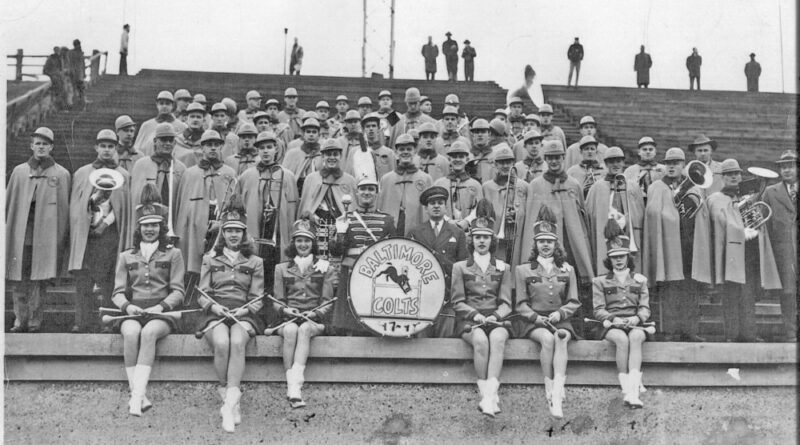
That same day, another Baltimore institution made its debut: the Baltimore Colts Marching Band. Although not the oldest marching band in professional football — that distinction belongs to the Washington Commanders Marching Band, founded in 1937 — it has remained the oldest continuously operating marching band in football history, and the first musical group to be included in the Pro Football Hall of Fame.
The group is now known as Baltimore’s Marching Ravens. In 2004, when I was in seventh grade, my best friend asked me to join the band with her, as her three sisters were already members. At that point, I had been playing alto saxophone since fourth grade. My reason for choosing sax was simple. During a school instrument demonstration, someone played the theme song to “The Simpsons” on alto sax. That was all I needed to hear — sign me up!
When I joined the band, it was an all-volunteer organization. I was around 13 at the time. Today, members must be over the age of 18. We practiced at the Howard County Fairgrounds in a building nicknamed the Cow Palace, where I learned to march and play on a bumpy, muddy field marked with traffic cones to warn us about deep divots and potholes.
My best friend eventually left the band, but I stayed — partly because no band member ever wanted to disappoint band president John Ziemann but mostly because I didn’t want to break my commitment to the organization. It had given me responsibility, leadership and community.
The band changed dramatically during my time. We began practicing at the team complex in Owings Mills on an indoor turf field with perfectly spaced yard lines (a very exciting upgrade). We participated in the 2007 Macy’s Thanksgiving Day Parade, marched in the SB XLVII parade, and the organization went from all-volunteer to part-time employees. The band was the subject of Barry Levinson’s “30 for 30” documentary titled, “The Band That Wouldn’t Die” (a must-see).
In Maryland, sports and community go hand in hand, even in ways we may not realize. When I joined the band, I thought it might look good on my high school applications. What I didn’t know was that it would lead me down my future career path. Through a series of connections, I work for the Babe Ruth Museum today because I joined the band in 2004. Members have made lifelong friends, found future spouses and experienced unforgettable historical moments — all while carrying Baltimore’s football history forward.
Since 1947, football in Baltimore has gone through many changes. There were the All-America Football Conference’s original Baltimore Colts, whose team colors were green, silver and white. There was the short-lived Colts franchise that followed the 1950 NFL merger, going 1-11 and folding in January 1951. Then there was the 1953 team that brought the iconic blue and white colors from the defunct Dallas Texans. Decades later, the Canadian Football League’s Baltimore Stallions brought home the Grey Cup in ’95. The Baltimore Ravens that we know today have been in town since 1996.
One of my favorite artifacts captures the band’s story perfectly. We see a Western-style, cowboy-inspired jacket, very clearly Baltimore Colts. This same jacket would be updated with a Stallions patch, then finally covered with a Ravens patch. The band has been through several uniform changes since then, but this artifact signifies the connection between past and future.
In September 2027, the band will celebrate its 80th anniversary. In the context of celebrating Maryland sports history in the past 250 years, this represents a significant piece. The passion and dedication of its members are unmatched. The band’s legacy is built on the intersection of sports and community and is a living celebration of Maryland pride.
And throughout all of that, the band has never stopped playing.
Katie Dick is the director of external affairs and curator at the Babe Ruth Birthplace and Museum.
For more Maryland sports history, visit PressBoxOnline.com/history
The Babe Ruth Birthplace and Museum is an independent not-for-profit organization dedicated to preserving the legacy of Babe Ruth and all Maryland sports. Visit the historic row home where George Herman “Babe” Ruth was born and discover treasures from Maryland’s storied sports heritage. Visitors can see the Baltimore Colts’ Super Bowl V Trophy, Jessica Long’s 2004 Paralympic gold medal, Ruth’s rookie card, and so much more.
Located a short walk from Oriole Park at Camden Yards, the Babe Ruth Museum is open 7 days a week, from 10 a.m. to 5 p.m..
Photo Credit: Courtesy of the Babe Ruth Birthplace and Museum